
![[headshot] image of customer (for a modern restaurant)](https://cdn.prod.website-files.com/69654cf02f2cae51edaa67f1/69bd8eff48a4bae194ee4d55_renewmind.jpg)

Thoughts on Trial is a very helpful tool that can help us live life with more balanced thinking, better emotional reactions and less unhelpful actions. Before we jump right into learning what this tool is, let’s take a look at some common, relatable experiences that many of us find ourselves in.
- Scenario 1: Sarah came home from work and scrolled on her phone. When her husband came home, he saw that she left a mess in the kitchen and dining room. They have talked about this multiple times before and her husband is getting increasingly upset. He brought it up harshly and it started an argument. Sarah thinks, “He must hate me.” As the evening goes on, Sarah feels anxious, rejected, and embarrassed. She sulks in her room.
- Scenario 2: Marcus makes a small mistake during a work presentation. Later, he thinks, “I completely blew it. I'm so bad at public speaking.” That thought leaves him feeling ashamed and tense. He spends the rest of the day replaying the mistake in his head and avoids speaking up in future meetings.
- Scenario 3: Emily steps on the scale and notices she’s gained a couple of pounds. Instantly, her mind declares, “I have no self-control. I’ll never be healthy.” She feels discouraged and angry at herself. In frustration, she skips her evening workout and orders takeout, feeling like it doesn’t matter anyway.
In each of these situations, the person’s thoughts weren’t necessarily based on facts—they were distorted interpretations. Those thoughts quickly shaped their emotions, which then drove their actions. This is something we all do. When we are cruising through our day, we often have trouble identifying when our thoughts are distorted because they feel so accurate in the moment. When our interpretations are distorted, they create unnecessary emotional pain and unhelpful behavior reactions. But, what if we could get better at catching those distortions before they take over? That’s where a tool called “Thoughts on Trial,” comes in. In the next section, we’ll break down how it works and how you can use it to challenge distorted thoughts and bring more balance to your emotional life.
What is the Thoughts on Trial Tool?
The Thoughts on Trial tool is a simple but powerful strategy for challenging distorted thoughts. It helps you pause and take a closer look at what your mind is telling you—and then ask yourself whether that thought is actually supported by facts. Instead of automatically believing your first interpretation, this tool encourages you to act like a detective: gather the evidence for and against the thought, and see if a more balanced, accurate perspective is possible. By slowing down and putting your thoughts on trial, you create space to respond more calmly and intentionally, rather than reacting based on assumptions.
How to Use the Tool
Using the Thoughts on Trial tool involves four simple steps:
- Identify the original thought.
- List the evidence that supports that thought.
- List the evidence that goes against it.
- Use that information to create a more balanced, realistic thought.
Let’s walk through it using Scenario 1, where Sarah and her husband get into an argument about housework. Her original thought is: “He probably hates me.” Here's how it might look when she uses the tool:
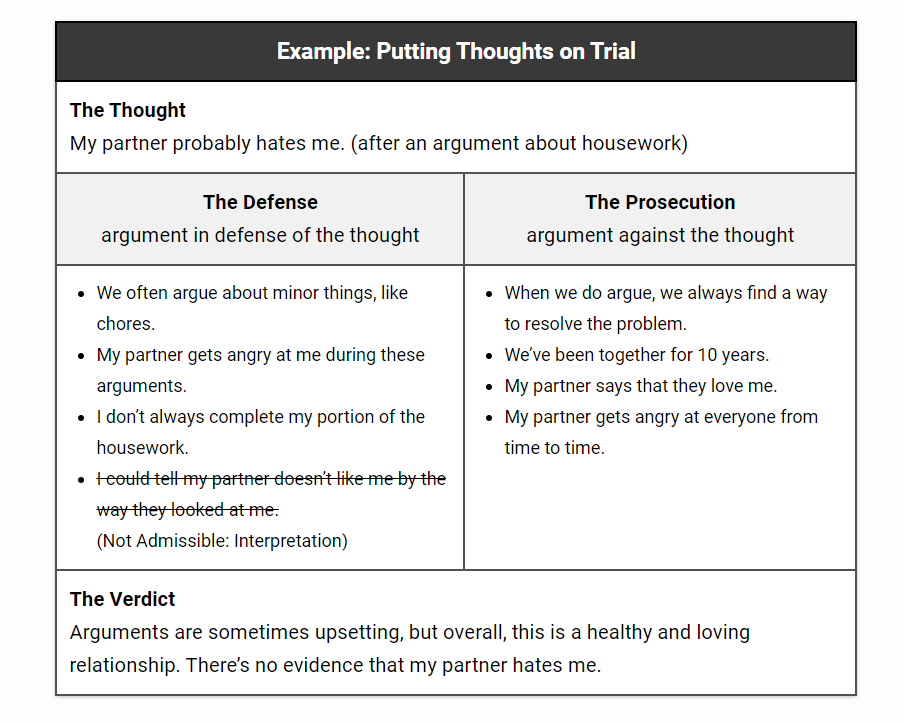
By laying out the evidence, Sarah can shift from a reactive, anxiety-fueled story to a more grounded and compassionate understanding of the situation. This doesn’t erase all of the stress from the argument, but it gives her space to respond in a calmer, more thoughtful way.
Final Thoughts
Now it’s your turn. Think back to a recent moment when you had a strong emotional reaction—maybe you felt anxious, frustrated, ashamed, or hurt. What was the situation? What thought ran through your mind in that moment? Once you’ve identified it, try walking through the same steps Sarah used. Write down your original thought, then list out the evidence that supports it and the evidence that goes against it. Finally, take a moment to write a more balanced thought that accounts for both sides. At first, this process might feel a bit slow or even unnatural—but with practice, it becomes second nature. The more often you pause to examine your thoughts, the better you’ll get at spotting distortions in real time. Over time, this habit can dramatically shift the way you respond to challenges. You’ll feel more emotionally steady, less reactive, and more in control of how you show up in your life. It's a small daily practice with a big long-term payoff.